
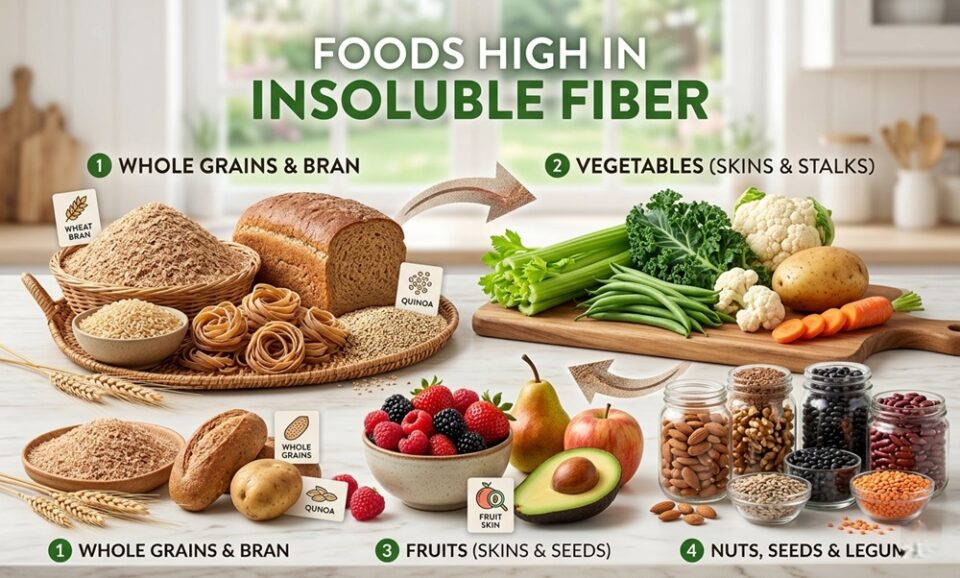
Foods high in insoluble fiber include wheat bran, whole grains, nuts, seeds, and most vegetable skins. Adding them daily improves digestion, prevents constipation, and supports gut health — without complicated meal changes.
Here’s exactly what to eat and how to add it.
What Is Insoluble Fiber? (Quick Answer)
Insoluble fiber is the type of dietary fiber that does not dissolve in water. It adds bulk to stool, speeds up food movement through the intestines, and feeds beneficial gut bacteria.
Unlike soluble fiber (which forms a gel), insoluble fiber acts like a scrub brush for your digestive tract.
Daily target: 20–38g total fiber, with insoluble fiber making up roughly 75% of that.
Top Foods High in Insoluble Fiber (Ranked by Fiber Content)
🌾 Grains & Cereals
| Food | Insoluble Fiber (per serving) |
|---|---|
| Wheat bran (¼ cup) | 6.0g |
| Whole wheat bread (1 slice) | 1.9g |
| Brown rice (1 cup cooked) | 1.8g |
| Oat bran (½ cup cooked) | 2.9g |
| Whole grain pasta (1 cup) | 2.4g |
🥦 Vegetables
| Food | Insoluble Fiber (per serving) |
|---|---|
| Green peas (½ cup) | 3.5g |
| Broccoli (1 cup) | 2.4g |
| Cauliflower (1 cup) | 2.1g |
| Kale (1 cup raw) | 1.3g |
| Carrots (1 medium) | 1.5g |
| Potato with skin (medium) | 2.3g |
🫘 Legumes & Beans
| Food | Insoluble Fiber (per serving) |
|---|---|
| Lentils (½ cup cooked) | 4.5g |
| Black beans (½ cup cooked) | 3.8g |
| Chickpeas (½ cup cooked) | 3.1g |
| Kidney beans (½ cup cooked) | 3.0g |
🥜 Nuts & Seeds
| Food | Insoluble Fiber (per serving) |
|---|---|
| Almonds (1 oz / 23 nuts) | 2.2g |
| Chia seeds (2 tbsp) | 5.5g |
| Flaxseeds, ground (2 tbsp) | 3.8g |
| Sunflower seeds (1 oz) | 2.0g |
🍎 Fruits (with skin)
| Food | Insoluble Fiber (per serving) |
|---|---|
| Apple with skin (medium) | 2.1g |
| Pear with skin (medium) | 3.1g |
| Raspberries (1 cup) | 4.6g |
| Avocado (½ fruit) | 3.4g |
| Banana (medium) | 1.7g |
Step-by-Step: How to Add Insoluble Fiber Foods Daily
Step 1 — Audit Your Current Diet
Write down what you ate yesterday. Identify how many items were processed (white bread, white rice, peeled vegetables). These are your swap targets.
Step 2 — Swap White for Whole
- White rice → brown rice or quinoa
- White bread → whole wheat or rye bread
- Regular pasta → whole grain pasta
This single change adds 3–5g of insoluble fiber daily.
Step 3 — Keep the Skins On
- Eat apple skin, pear skin, potato skin
- Don’t peel zucchini, cucumber, or carrots
Skin = where most insoluble fiber lives.
Step 4 — Add a Fiber Anchor to Every Meal
- Breakfast: 2 tbsp wheat bran stirred into yogurt or oatmeal
- Lunch: Side of broccoli, peas, or leafy greens
- Dinner: ½ cup legumes (black beans, lentils) or brown rice
- Snack: Handful of almonds or raspberries
Step 5 — Increase Slowly (Critical)
Jumping from low to high fiber too fast causes bloating and cramps.
- Week 1–2: Add one high-fiber food per day
- Week 3–4: Add two high-fiber foods per day
- Week 5+: Reach your daily fiber target
Step 6 — Drink More Water
Insoluble fiber needs water to work. Without it, you’ll feel more constipated, not less.
Aim for 8–10 cups (2–2.5L) of water daily when increasing fiber intake.
Common Mistakes to Avoid
- ❌ Adding too much fiber at once — causes gas, bloating, cramping
- ❌ Not drinking enough water — fiber without water worsens constipation
- ❌ Relying on fiber supplements instead of whole foods — supplements lack vitamins and phytonutrients
- ❌ Peeling all fruits and vegetables — you lose up to 30% of the fiber
- ❌ Overlooking legumes — they’re among the cheapest and densest fiber sources available
- ❌ Eating only one type of fiber food — variety feeds more gut bacteria strains
- ❌ Assuming “multigrain” means high fiber — always check the label; many multigrain products have very little actual fiber
Quick Tips
💡 Tip 1: Add 1 tbsp of ground flaxseed to smoothies, soups, or yogurt — it’s nearly tasteless and adds 2g of fiber instantly.
💡 Tip 2: Frozen vegetables (broccoli, peas, green beans) have the same fiber as fresh — and they’re cheaper.
💡 Tip 3: Canned beans count. Rinse them to reduce sodium, and you have a ready-to-use fiber source in under 60 seconds.
💡 Tip 4: Raspberries have more fiber per cup than almost any other fruit (8g total). Keep a bag frozen.
💡 Tip 5: If you’re eating out, choose sides with vegetables or beans rather than fries or white rice.
Insoluble Fiber vs. Soluble Fiber — What’s the Difference?
| Feature | Insoluble Fiber | Soluble Fiber |
|---|---|---|
| Dissolves in water? | No | Yes |
| Main function | Adds bulk, speeds digestion | Slows digestion, lowers cholesterol |
| Best for | Constipation, colon health | Blood sugar, heart health |
| Found in | Wheat bran, skins, nuts | Oats, apples, beans, psyllium |
Most whole foods contain both types. You don’t need to obsess over which is which — focus on eating a variety of whole plant foods.
FAQ
Q: How much insoluble fiber do I need per day? A: Adults need 25–38g of total dietary fiber daily. Approximately 75% should come from insoluble sources — that’s roughly 19–28g of insoluble fiber per day.
Q: What is the single best food source of insoluble fiber? A: Wheat bran is the most concentrated source, providing about 24g of insoluble fiber per 100g. A ¼ cup serving adds ~6g with minimal calories.
Q: Can too much insoluble fiber be harmful? A: Yes. Exceeding 70g total fiber daily without adequate water can cause bloating, intestinal blockages, and reduced absorption of minerals like zinc, iron, and calcium.
Q: Is insoluble fiber good for weight loss? A: Yes. It increases meal bulk without calories, slows stomach emptying, and can reduce overall calorie intake by improving satiety.
Q: Do cooking methods affect insoluble fiber content? A: Slightly. Boiling vegetables softens fiber but doesn’t eliminate it. Steaming or roasting preserves more fiber structure than overcooking.
Q: What are the best insoluble fiber foods for people with IBS? A: IBS varies by individual. Some with IBS-C (constipation-dominant) benefit from gradual fiber increases. Those with IBS-D (diarrhea-dominant) should introduce insoluble fiber very slowly and consult a dietitian. Low-FODMAP high-fiber options like carrots, zucchini, and quinoa are often better tolerated.
Q: Are fiber supplements a substitute for food? A: No. Fiber supplements (psyllium husk, methylcellulose) lack the vitamins, minerals, antioxidants, and phytonutrients found in whole foods. Use them only to supplement a fiber-poor diet, not replace it.
Summary: Top 10 Insoluble Fiber Foods to Start With
- Wheat bran
- Lentils
- Raspberries
- Chia seeds
- Black beans
- Broccoli
- Almonds
- Brown rice
- Apple (with skin)
- Whole wheat bread
Add 2–3 of these daily, keep the skins on your produce, swap white grains for whole grains, and drink plenty of water. That’s the entire strategy.
