
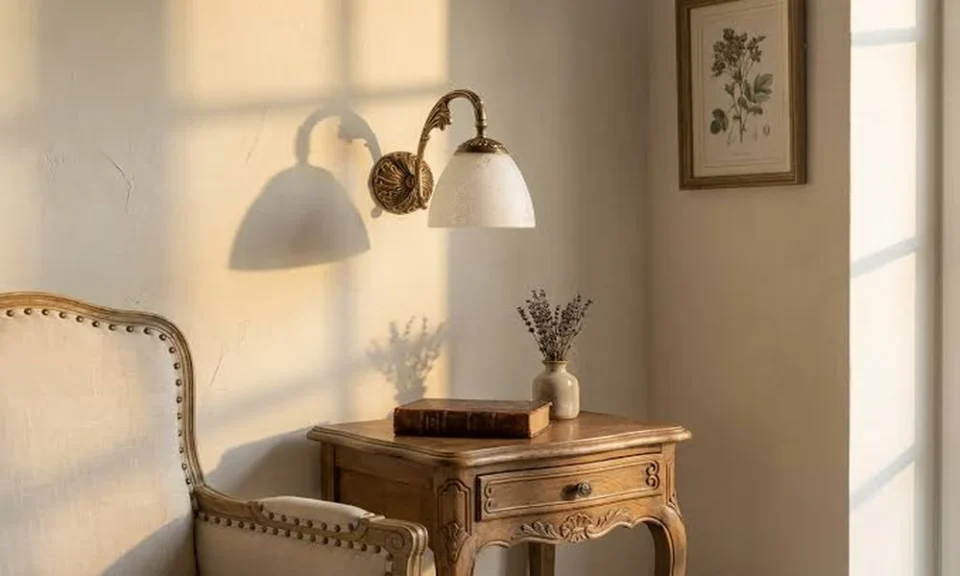
Most vintage lamps fail for a boring reason: nobody checked the shade. The base is gorgeous, the brass is patinated just right, and the room still looks dim because a wide drum shade threw light sideways instead of down onto your book. A lamp is a lighting tool first and a sculpture second, and getting both at once takes about ten minutes of actual measuring before you fall for a finish.
Here’s the good news. Secondhand lighting is one of the few categories where older often beats new, since the hardware tends to be metal instead of plastic and the shades can be swapped. If you’re building out a room and want period-correct pieces rather than reproductions, browsing a modern table lamps collection is a fast way to see what the market actually holds at real prices, from Danish teak to Hollywood Regency ceramic. The trick is knowing what to look for once you’re standing in front of one.
Start with the job, not the lamp
Every table lamp in your house is doing one of three jobs, and mixing them up is how rooms end up with five pretty objects and no usable light.
- Task light: reading, knitting, paperwork. Needs a focused throw and a bulb bright enough to work under.
- Ambient light: fills a corner, softens a wall, makes a sofa area feel finished after sunset.
- Accent light: highlights a shelf, a plant, a piece of pottery. Mostly decorative, low output on purpose.
Write down which job you’re filling before you shop. I’d argue the task light is the one worth spending real money on, because that’s the lamp you’ll physically sit next to for years. Accent lamps can be cheap finds. Task lamps have to work.
The Lumen Ladder: my three-step buying check
I use a simple sequence every time I evaluate a vintage lamp, and it has saved me from more bad purchases than any style rule. I call it the Lumen Ladder because you climb it in order and stop as soon as a lamp fails a rung.
- Rung one: the socket and cord. Look at the socket type. A standard medium base takes the widest range of bulbs, including LED replacements. Then check the cord for cracks, brittleness, or tape. Original cloth cords look fantastic and can be a fire risk, so plan on a rewire unless the seller has documentation. If you’re not comfortable doing that work, budget for an electrician.
- Rung two: the shade math. Shade diameter should roughly match the base height, and the bottom of the shade should sit around eye level when you’re seated. Too tall and you’ll see the bulb. Too wide and light scatters into the ceiling. Bring a tape measure to any in-person sale, and ask for base and shade dimensions in writing if you’re buying online.
- Rung three: the bulb plan. Vintage lamps were built for incandescent bulbs, which run hot and draw more power. Swapping to LED changes the output and the color. Modern LED bulbs use a fraction of the electricity of the incandescent bulbs these lamps were designed around, per the Department of Energy, so plan for a warm white LED in the 2700K range and check that the shape fits under the shade without poking out.
What does the finish actually tell you?
Patina is a feature on solid brass and a warning sign on plated metal. Rub a hidden spot with your thumb. If the gold color lifts and you see a dull gray underneath, that’s plating, and it will keep flaking. Ceramic is more forgiving, honestly, because chips can be touched up or hidden at the back. Wood bases should feel solid at the joints with no wobble when you press down on one side.
Mid century pieces have their own quirks worth knowing. Walnut and teak bases often have thin veneers, so a single deep gouge can expose the substrate. Lucite and acrylic lamps scratch if you look at them wrong, and those scratches catch the light. None of that disqualifies a piece. It just tells you whether the price makes sense.
The showroom test you can do in ninety seconds
Here’s a scenario I run every time. Picture a shop in Long Beach with forty lamps jammed onto shelves, and you’ve got ten minutes before closing. Grab the lamp, set it on a sturdy table at seat height, and sit down in front of it with a book. Plug it in if the shop allows. Now look at three things.
First, is the light landing on the page or on your forehead? Second, does the shade throw a hard hotspot on the wall behind it, or a soft wash? Third, can you reach the switch without standing up? That last one sounds trivial and it isn’t. A lamp you have to get up to turn on will stay off, and a dark corner stays dark.
I’d skip any lamp the shop won’t let you plug in. That’s a polite way of saying the wiring is questionable.
Matching lamps to the rooms people actually have
Design magazines shoot rooms with perfect ceiling heights. Your apartment probably has eight feet and a radiator. So here’s a plain label section with no poetry in it.
- Bedside: go small. A base under about 20 inches tall with a shade that sits below your shoulder line while you’re propped up on pillows. Symmetry is optional, and honestly two different lamps flanking a bed looks more collected than a matched pair.
- Living room side table: this is your task light. Something with a bit of weight so a cat can’t knock it over, and a shade that directs light downward.
- Console or entryway: this is accent territory. A sculptural ceramic or a chrome piece that reads as art from the front door. Output barely matters here.
Home office: pick a lamp with a switch you can hit without looking, and put it on the opposite side of your writing hand so you don’t cast a shadow across your work. If you’re buying for an office with a shared floor plan, the General Services Administration maintains design guidance on workplace lighting that’s worth a skim for the ergonomic basics.
Price, condition, and when to walk away
Secondhand lighting pricing swings wildly, and condition explains most of the gap. A lamp with original wiring and a tired shade should cost less than a rewired one with a fresh shade, even if the bases look identical. Add the cost of a rewire and a new shade before you compare two pieces, because a $150 find can turn into a $400 project fast.
Walk away when the frame is bent at the neck, when the switch grinds, or when the shade ring is missing and you can’t source a replacement size. Those are structural problems dressed up as cosmetic ones.
Buy the base for its shape and material. Buy the shade as a consumable, because you will probably replace it anyway.
Pulling the room together
You don’t need a matching set. You need three lamps doing three different jobs, at heights that don’t compete, with shades that don’t fight each other on color temperature. Buy one warm bulb brand and stick with it across the whole room, because mismatched color temperatures are the single most common reason a well-furnished room looks off in photos. That’s my hill, and I’m staying on it.
Start with the task lamp. Sit in the chair you actually read in, measure the height of your shoulder, and go shopping with that number in your head. Then come back and tell me whether the shade math changed what you bought, because it usually does.
