
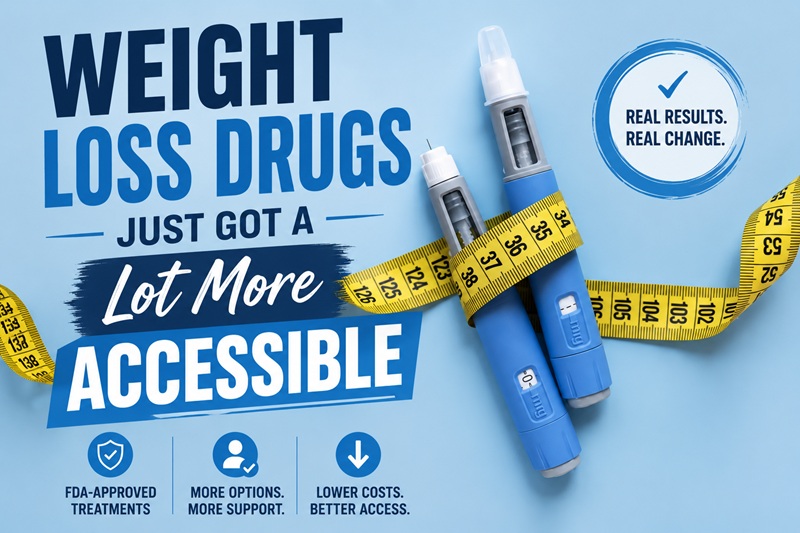
For years, GLP-1 medications like Wegovy and Zepbound have been effective but genuinely hard to afford for a huge chunk of the people who could benefit from them. That’s finally starting to shift. Medicare just opened the door to coverage for the first time ever, and the drugs themselves are evolving in ways that could make them cheaper and easier to take. Here’s what’s actually going on.
Medicare Is Covering Weight Loss Drugs for the First Time Ever
This is genuinely a first. Medicare has long been barred from covering medications prescribed purely for weight loss, but a new pilot program called the Medicare GLP-1 Bridge just changed that, offering eligible beneficiaries access to Wegovy, Zepbound, and a newer option called Foundayo for a flat $50 monthly copay. It’s a notable departure from decades of policy that only allowed coverage when these same drugs were prescribed for diabetes or heart disease, not obesity itself.
Millions of People Could Qualify, But Not Everyone Will Use It
The numbers here are massive on paper. Roughly 15 to 20 million older adults on Medicare are estimated to meet the eligibility criteria, which is based mainly on body mass index along with a qualifying condition like prediabetes or heart disease. Even so, budget forecasters expect a much smaller number to actually start treatment in the near term, since a monthly copay, even a discounted one, still adds real cost for beneficiaries living on a fixed income.
The Program Has a Built In Expiration Date
Here’s the catch that’s easy to miss in the headlines. The Bridge program is explicitly temporary, running only through the end of next year, and it was designed as a stopgap before a longer term plan that would shift coverage responsibility onto private Part D insurers. That longer term plan has already hit a snag though, since some of the country’s biggest insurers declined to participate voluntarily, citing concerns about cost and structure. What happens after the bridge program ends is genuinely still an open question.
Obesity Rates Are Finally Ticking Down
Behind all the policy news, there’s a real public health signal worth paying attention to. New survey data shows the national obesity rate has seen a meaningful decline even as GLP-1 use has climbed to a new high, suggesting these medications may be having a measurable population level effect rather than just helping individual patients one at a time.
A New Pill Version Could Solve the Biggest Access Problem
Separately from the Medicare news, the science behind these drugs keeps advancing too. A recent clinical trial found that a new oral small molecule GLP-1 drug produced up to 12 percent weight loss over 36 weeks, a meaningful result given that most current GLP-1 treatments have to be injected. Injectable formulations come with real practical barriers, refrigeration requirements, needle anxiety, and higher manufacturing costs, so an effective pill version could dramatically widen who’s able to access this kind of treatment.
Regaining Weight After Stopping Remains a Real Concern
None of this comes without caveats. Research has consistently shown that people who stop taking these medications tend to regain a significant portion of the weight they lost, with one study finding patients regained roughly two thirds of their prior loss within a year of stopping. It’s a strong argument for thinking about GLP-1 treatment as a long term commitment rather than a short term fix, which has real implications for how insurers and patients alike should be planning around cost.
The Bottom Line
Weight loss medication is having a genuinely pivotal stretch right now, with Medicare opening real financial access for the first time and the underlying science pushing toward a more convenient, more affordable pill based future. The next year and a half will tell us a lot about whether wider access actually translates into better long term health outcomes, or whether cost and commitment issues keep holding people back even with the door finally open.
This content is for general informational purposes and isn’t medical advice. Talk to a doctor about whether a weight loss medication is right for you.
